
Views: 0 Author: Site Editor Publish Time: 2025-08-11 Origin: Site
A treadmill mat may appear to be a simple fitness accessory, but its material, thickness, surface construction, and manufacturing quality can significantly influence floor protection and equipment stability.
Whether installed beneath a treadmill in a home gym or used with multiple cardio machines in a commercial fitness facility, a properly selected equipment mat helps protect flooring from scratches, moisture, and concentrated equipment loads. Depending on its construction and the installation environment, it can also help reduce transmitted vibration and improve everyday cleaning efficiency.
For gym owners, fitness equipment distributors, and private-label brands, choosing the right treadmill mat involves more than comparing prices. Understanding material performance, production consistency, and manufacturer capabilities is essential for long-term product reliability.
This guide explains the key factors to consider when selecting a treadmill mat and explores how professional OEM manufacturing can support different fitness equipment applications.
Selecting the appropriate mat dimensions is the first step toward effective floor protection.
Measure the overall footprint of the treadmill, including its supporting feet and any components that contact the floor. Ideally, the mat should extend slightly beyond the equipment's contact points to provide adequate coverage and allow easier cleaning around the machine.
Compact walking pads generally require smaller mats, while full-size treadmills and commercial cardio equipment may need larger formats.
However, an oversized mat is not automatically better. Buyers should also consider room dimensions, surrounding floor transitions, machine ventilation, and the equipment manufacturer's installation requirements.
For commercial gyms, standardized mat dimensions can simplify equipment installation, replacement purchasing, and inventory management.

Material selection affects cushioning, durability, traction, weight, and maintenance requirements. The three commonly used options are PVC foam, rubber, and EVA foam.
High-density PVC foam provides a combination of flexibility, cushioning, and practical floor protection. Its textured surface and relatively lightweight construction make it suitable for many home gym and commercial fitness equipment applications.
PVC foam mats are also well suited to manufacturers requiring different thicknesses, surface finishes, and custom dimensions.
Rubber mats are generally heavier and are frequently selected for demanding fitness environments. Their performance depends on the rubber compound, density, thickness, and surface construction.
They can be appropriate for heavier equipment, but buyers should consider product weight, odor, cleaning requirements, and compatibility with sensitive flooring materials.
EVA foam is lightweight and offers cushioning, making it useful for selected low-load fitness and exercise applications.
However, softer EVA products may experience greater compression under concentrated equipment loads. Material density and long-term dimensional stability should therefore be evaluated before using them beneath heavy treadmills.
The most suitable material depends on equipment weight, expected usage intensity, floor conditions, and maintenance requirements.

Treadmill mat thickness affects cushioning and the way loads are distributed across the floor. However, thicker materials do not necessarily provide better performance in every installation.
Density, compression behavior, and material resilience must also be considered. A mat that is excessively soft may deform beneath the treadmill's supporting feet, potentially affecting equipment stability.
For reference, FXH PVC Foam Treadmill Mats are available in 4 mm, 6 mm, 8 mm, and 10 mm thickness options.
Thinner constructions may be appropriate for compact fitness equipment and applications with limited floor clearance, while thicker constructions may provide additional cushioning when matched to suitable material density.
For commercial purchasing, thickness tolerance, compression resistance, and consistency between production batches are important considerations.

A treadmill mat should provide a stable interface between the equipment and the underlying floor.
Textured surfaces can improve contact with equipment feet, while a suitable backing structure helps reduce unwanted mat movement. Performance depends on the combination of surface design, material formulation, equipment weight, and floor conditions.
FXH offers PVC foam treadmill mats with pebble and leather-style surface textures, together with textured anti-slip backing options.
For gym owners and distributors, evaluating the complete mat construction is more useful than relying on the appearance of a single surface pattern.
Products should be tested under realistic operating conditions, particularly when used on smooth tiles, timber, vinyl flooring, or other surfaces where movement or material interaction may occur.
Treadmills generate repetitive vibration during walking and running. Depending on the building structure and flooring system, some of this energy may be transmitted through the floor.
A properly selected treadmill mat can help dampen vibration at the equipment–floor interface. High-density foam and rubber constructions are commonly considered for this purpose.
However, vibration control should not be confused with complete soundproofing. Actual results depend on equipment design, operating speed, mat properties, floor construction, and surrounding building conditions.
For upstairs gyms, apartment fitness rooms, or shared commercial spaces, buyers should consider both equipment isolation and the wider acoustic requirements of the building.

Different flooring materials require different installation considerations.
On hardwood, laminate, and vinyl flooring, protection against pressure marks, scratches, and potential material discoloration is important. On carpet, buyers should evaluate equipment stability, mat compression, and the influence of carpet pile thickness. Concrete floors may tolerate higher loads but can still benefit from surface protection and vibration management.
Not every PVC or rubber formulation is compatible with every finished floor. Where necessary, obtain flooring-manufacturer guidance and test material compatibility before extended use.
The mat should also be appropriate for the type of exercise equipment being installed.
In addition to treadmills, properly specified equipment mats can be used beneath walking pads, stationary exercise bikes, rowing machines, elliptical trainers, and selected strength equipment.
Different machines may require different mat dimensions, thicknesses, and surface structures. A professional manufacturer should therefore be able to support more than one standard product specification.
For wholesale buyers, manufacturing consistency is just as important as the appearance of the finished product.
Variations in foam density, thickness, surface texture, and cutting accuracy can affect installation quality and customer satisfaction. These factors become especially important when a distributor purchases multiple sizes or develops a complete equipment mat product range.
A professional manufacturing process should address material selection, controlled foaming, surface texturing, cutting, edge finishing, product inspection, and packaging.
Clear production specifications and sample approval procedures help ensure that products supplied in subsequent orders remain consistent with the agreed requirements.
FXH (All Mats Group) is a China-based floor mat manufacturer specializing in commercial, industrial, household, and sports matting products. Its PVC foam treadmill mat manufacturing capabilities support distributors, fitness equipment suppliers, and private-label brands seeking customizable floor protection products.
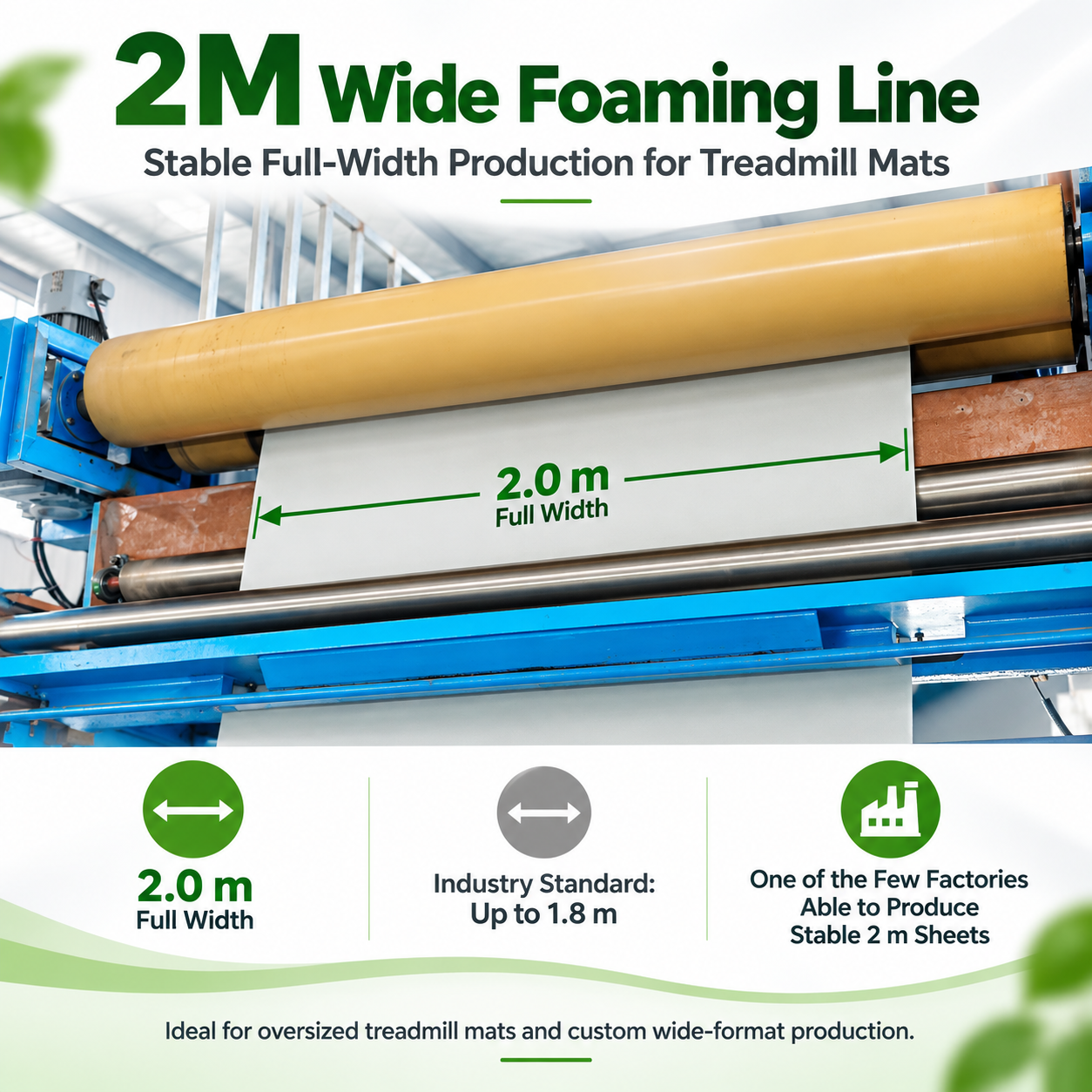
FXH operates a PVC foam production line supporting material widths of up to 2 meters.
This manufacturing capability allows larger treadmill and equipment mats to be produced in continuous widths without unnecessary joining seams, depending on the required dimensions.
For distributors developing large-format gym mats, greater production width provides additional flexibility in product sizing and cutting specifications.
According to FXH's published factory information, its PVC foam manufacturing operation has a stated maximum production capacity of up to 3,000 square meters per day.
This capacity supports wholesale production planning and gives buyers an indication of the factory's manufacturing scale. Actual output and delivery schedules depend on product thickness, dimensions, customization requirements, and production scheduling.
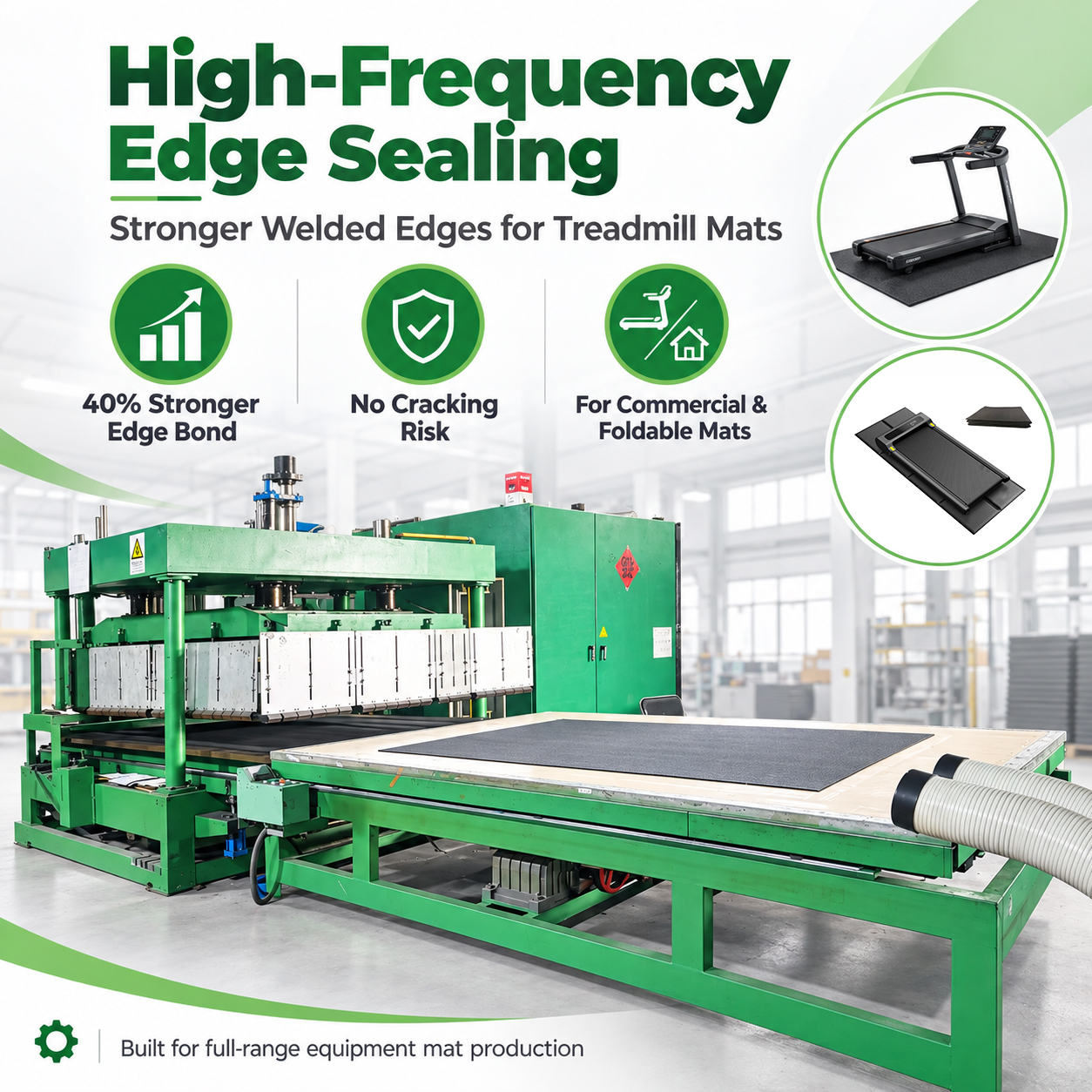
FXH also utilizes high-frequency welding equipment for selected large-format PVC mat applications requiring joined or sealed constructions.
Combined with cutting and finishing processes, this capability expands the range of dimensions and product configurations available for customized orders.
Depending on the specification, the factory offers natural or heat-sealed edges and different corner-finishing options.
FXH's production workflow covers material preparation, PVC foaming, surface processing, precision cutting, edge finishing, branding, inspection, and packaging.
Its automated packaging facilities support standardized packing procedures for wholesale and export orders.
Available packaging options include protective shrink wrapping, printed paper wraps, retail labels, cartons, and other customized packaging formats.
This integrated approach allows buyers to coordinate both product specifications and retail presentation within a single manufacturing program.
FXH supports OEM and ODM customization involving dimensions, thickness, material weight, surface texture, color, and branding.
For fitness equipment brands and distributors, this flexibility can help develop coordinated mat collections for treadmills, walking pads, exercise bikes, rowing machines, and other equipment categories.
Custom logos, packaging artwork, and retail labeling can also be incorporated into selected orders.
Rather than supplying only one fixed treadmill mat specification, FXH can support different product configurations designed around equipment type, target market, and sales channel.
When sourcing treadmill mats directly from a manufacturer, buyers should establish clearly defined product specifications before confirming production.
Material composition, thickness tolerance, density, dimensions, surface texture, backing construction, and edge finishing should be agreed upon during the sample approval process.
For private-label projects, branding methods, packaging artwork, carton specifications, and labeling requirements should also be confirmed.
Product inspection procedures are another important consideration. Buyers may request relevant material test reports, dimensional inspection records, and finished-product samples according to the intended market and applicable requirements.
For large orders, production capacity should be evaluated together with confirmed lead times, quality-control arrangements, and logistics planning.
A reliable supplier should be able to communicate these requirements clearly and provide appropriate documentation for the agreed product specification.
There is no universal ideal thickness. The most suitable option depends on treadmill weight, supporting-foot design, mat density, and flooring conditions. Common PVC foam options include 4 mm, 6 mm, 8 mm, and 10 mm, but thicker mats should be evaluated for adequate stability under load.
A suitable mat can help dampen vibration transmitted through the equipment–floor interface. The actual reduction depends on material properties, equipment operation, and building construction, and should not be assumed without testing.
Some equipment mats can be used beneath treadmills, exercise bikes, rowing machines, and other machines when their dimensions, load capacity, and material construction are appropriate. Different equipment types may require different specifications.
Yes. Manufacturers with OEM capabilities, such as FXH, can offer selected customization options involving dimensions, thicknesses, surface finishes, branding, and retail packaging, subject to manufacturing feasibility and order requirements.
Choosing the right treadmill mat requires balancing material performance, dimensions, thickness, surface grip, floor compatibility, and maintenance requirements.
For individual gym owners, the priority is selecting a stable, durable mat appropriate for the treadmill and flooring environment. For distributors, fitness equipment manufacturers, and commercial buyers, consistent manufacturing quality and reliable production support are equally important.
With its wide PVC foam production line, dedicated finishing capabilities, automated packaging processes, and OEM customization services, FXH offers a manufacturing option for businesses developing treadmill and fitness equipment mat product ranges.
By considering both product specifications and supplier capabilities, buyers can make more informed decisions and develop equipment mat solutions suited to their intended applications.


