
Views: 0 Author: Site Editor Publish Time: 2026-01-06 Origin: Site
Jump rope (rope skipping) is a compact, inexpensive, and highly scalable form of aerobic and neuromuscular training. Yet the movement pattern—high-frequency cyclic impacts on the lower extremity—creates a predictable set of risks: repetitive loading to the ankle–knee kinetic chain, accelerated wear on flooring surfaces, and impact noise transmission that can undermine indoor usability (especially in apartments and shared buildings). This paper argues that the jump rope mat is best understood as a micro-intervention: a small, low-cost change to the exercise environment that can reduce mechanical and acoustic externalities without changing the training goal. Drawing on biomechanics and building-acoustics research, we explain (1) why a mat is needed for jump rope, (2) what functions a mat must provide, and (3) how to choose the correct mat using measurable criteria (material, thickness, stiffness, friction, dimensions, and durability). The discussion concludes with practical selection heuristics and an implementation checklist for home gyms and commercial studios.
Keywords: jump rope mat, skipping mat, impact loading, shock absorption, floor protection, impact sound, non-slip surface, PVC foam

Jump rope is often marketed as “simple cardio,” but mechanically it is closer to a repeated jump-landing task performed at high cadence. That matters, because repeated landing impacts can accumulate load in bones, tendons, and joints when recovery and damping are insufficient. A jump rope mat does not replace good technique or appropriate footwear—but it can improve the training interface (the shoe–surface system), which research shows can influence impact mechanics during jump tasks.
From a performance and safety standpoint, the question is not whether we can jump rope without a mat (we can), but whether we should accept avoidable costs—noise complaints, scuffed floors, rope wear, and higher perceived harshness—when a purpose-built surface can reduce them. In practice, this is exactly where specialized products sit. For example, FXH’s Jump Rope Mat is positioned as a PVC-foam, non-slip, shock-absorbing layer offered in multiple thicknesses and standard sizes for home and gym settings.

The defining feature of rope skipping is repetition. Even modest sessions can include hundreds to thousands of ground contacts. Over time, repetitive loading is widely hypothesized to contribute to overuse injuries when tissue microdamage accumulates faster than repair—especially when loads are high and recovery is limited. A rope-skipping biomechanics study in adolescents highlights the underlying concern: during high-frequency skipping, high peak vertical ground reaction force (VGRF) and load rate can increase long-term lower-limb injury risk.
Critically, the same study provides quantitative context. Comparing two common skipping styles—bounced jump (both feet together) vs alternating jump (single-foot alternation)—the reported peak GRF was about 20.24 ± 1.89 body weights (BW) for bounced jump and 24.91 ± 2.71 BW for alternating jump, while average loading rate differed substantially (365.68 ± 51.40 BW/s vs 510.73 ± 94.02 BW/s).
Even if these values are population- and protocol-specific, they illustrate the principle: jump rope is an impact-dominant activity, and technique changes the magnitude of impact exposure.
Research on jump tasks indicates that “cushioning” at the interface—whether from footwear or sports flooring—can influence impact forces and loading rate variables in standardized jump protocols.
This does not mean that softer is always better; human neuromuscular control adapts. But it supports a practical stance: the surface is not neutral, and thoughtful surface selection can be part of injury-risk management.
Floor protection. Jump rope is not only foot-to-floor impact; it is also rope-to-floor contact. Over time, this can scuff wood, scratch tile finishes, and abrade the rope itself. A mat creates a sacrificial layer that is cheaper to replace than flooring or frequent ropes.
Impact noise and vibration. Apartments and multi-use buildings amplify the “externalities” of exercise. Building-acoustics standards explicitly recognize the need to measure impact sound insulation and even reference heavy/soft impact sources intended to simulate activities such as barefoot walking or children jumping. Empirical work on floor mats shows that added layers can reduce standardized impact sound levels, though performance varies by mat type and floor structure.
In other words: if you jump rope indoors, a mat is not a luxury accessory—it is a tool for coexistence.
Protect The Floor
Reduce Noise
A jump rope mat is sometimes confused with a yoga mat. The functional requirements are different. Yoga mats prioritize comfort and grip in low-impact postures; jump rope mats must tolerate repeated, localized impacts and rope strikes while staying dimensionally stable.
A good mat should attenuate peak impact and/or slow the rate at which forces rise (loading rate). In jumping tasks, impact-related metrics such as peak vertical ground reaction force and vertical instantaneous loading rate are commonly used to assess “harshness” at landing.
Mechanistically, a mat can help by:
Increasing deformation time(spreading the impulse over a slightly longer interval)
Reducing peak contact pressure(by distributing load)
Adding damping(converting a portion of mechanical energy into heat)
Important nuance: the mat is one component of the interface. Technique (knee/hip flexion strategy) and shoes also influence loading. For instance, a jumping-rope study comparing barefoot vs shod conditions reported that wearing shoes reduced peak loading rate during alternating jump rope skipping.
The practical takeaway: choose a mat that complements good footwear and technique rather than trying to “solve” everything with softness.
Because jump rope includes lateral micro-adjustments and high cadence, mat slippage can be more dangerous than “hardness.” The mat must provide:
High friction at the bottom surface(mat-to-floor grip)
Predictable grip on the top surface(shoe-to-mat contact)
A textured backing and surface are common design responses. FXH’s Jump Rope Mat, for example, specifies a non-slip back texture and a textured surface (pebble) aimed at stable footing.
Rope strikes on abrasive concrete or rough tile edges accelerate fraying. A mat provides a smoother, more consistent strike plane. Over time this can reduce the number of ropes consumed—an overlooked cost for frequent jumpers and commercial studios.
Impact noise is not just “loudness.” It includes structure-borne vibration transmitted through slabs and framing. Research on floor mats in apartment contexts shows that mats can achieve measurable reductions in standardized impact sound under certain impact sources and conditions, including rubber-ball drops used to simulate child-like impacts.
While jump rope is not identical to those standardized tests, the direction is consistent: a resilient layer can reduce transmitted impact energy—especially in frequency ranges that otherwise travel well through building structures.
In real training spaces, mats see sweat, dust, and skin oils. A practical jump rope mat should be wipe-clean and moisture resistant. PVC-foam designs are commonly chosen for that reason; FXH explicitly positions its mat as easy to clean and moisture resistant for indoor use.
Choosing a mat is easier when you treat it like a materials-and-use-case matching problem rather than a brand problem. Below is a selection framework that can be used for home users, gym owners, and distributors.
**Apartment / shared building (noise-sensitive):**Prioritize damping and stability. Aim for a mat that resists “bottoming out” and includes a grippy backing. Noise outcomes are influenced by the floor structure; studies show mat performance can vary with slab thickness and test-bed conditions.
**Garage / concrete floor (damage + harshness):**Prioritize durability, abrasion resistance, and moderate cushioning. Concrete is unforgiving; a mat protects both your joints and your rope.
**Commercial studio (high traffic):**Prioritize compression set resistance, tear resistance, and easy cleaning. Consider mats that can be ordered in consistent batches and replaced predictably.
A common mistake is buying a mat that fits your feet but not your rope. If the rope regularly hits outside the mat, you lose noise reduction and rope protection.
Practical sizing heuristics:
If you practice single-unders and doubles at high cadence, go wider/longer to capture rope strike zones.
If space is limited, prioritize widthfirst (rope strike often flares laterally more than expected).
FXH lists standard sizes such as 133×75 cm, 150×80 cm, and 115×62 cm—dimensions that generally allow both stance and rope strike coverage for many adults.
Thickness is not automatically better. Too thin may transmit harshness and noise; too thick may feel unstable or cause ankle “wobble” (especially for beginners).
A pragmatic way to choose:
**Beginners / balance concerns:**moderate thickness with good surface traction
**Noise-sensitive settings:**slightly thicker or more damping-oriented material
**Speed-focused athletes:**stable, not overly soft (to preserve rhythm and reduce energy loss)
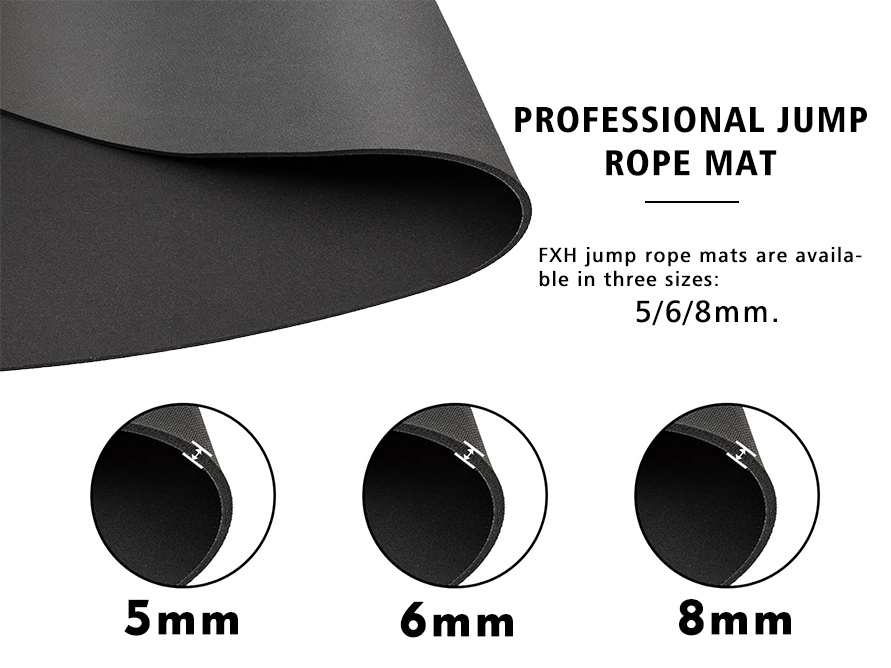
FXH offers 5 mm / 6 mm / 8 mm thickness options and provides stiffness information (e.g., 30 Shore C)—useful specs because they help you compare “feel” beyond thickness alone.
PVC foam mats are popular because they balance:
Damping(impact energy absorption)
Wipe-clean maintenance
Dimensional stability
Manufacturability at scale(important for commercial supply)
FXH describes its jump rope mat as PVC foam with a high-density foam structure designed to reduce noise and protect floors while providing non-slip performance.
When evaluating any PVC-foam mat (FXH or otherwise), verify:
Odor and compliance claims relevant to your market
Surface texture that grips shoes without “grabbing” the rope
Edge finishing (heat-sealed edges can reduce fray and curling)
Ask two questions:
Will the mat slide on myfloor (wood, tile, laminate, concrete)?
Will my shoes grip the mat during rapid cadence and direction micro-corrections?
Textured backing and a non-slip bottom pattern are not marketing fluff—they are risk controls. FXH lists a non-slip back texture, which is the right kind of specification to look for.
For high-frequency use, durability is often the hidden differentiator. A mat can “look fine” but lose damping if it permanently compresses (compression set) or develops edge curl that becomes a trip hazard.
Signs a mat is mismatched:
You feel the hard floor “through” the mat after a few weeks
The mat migrates during training despite a clean floor
Edges curl upward or crack
Rope marks become deep grooves (excessive surface wear)
A key insight from building-acoustics research is that measured impact sound reduction depends on both the mat and the floor structure. For example, a controlled study of floor mats in apartment-like test beds reported that heavy-weight impact sound reductions varied by mat type and test conditions, while a rubber-ball drop condition simulating child behavior (0.4 m drop) could achieve single-number reductions on the order of several dB (e.g., ~3–9 dB in one set of conditions).
That is meaningful, but not magic. Noise perception is context-dependent; still, even a few dB can be the difference between “annoying” and “tolerable” for neighbors in quiet buildings.
To turn “a good mat” into a good outcome:
Clean the floorwhere the mat sits (dust reduces friction).
Let the mat lie flatbefore first use (especially after shipping).
Use appropriate footwearif your joints are sensitive—shoe condition can affect loading rate during skipping.
**Pick a technique you can control.**If you alternate-jump at very high cadence, be aware that peak GRF and loading rates can be higher than bounced jumps in at least one adolescent dataset.
Monitor wearmonthly (edges, compression feel, slippage). Replace the mat before it becomes a hazard.
Discussion: The Mat as Part of a System, Not a Standalone Fix
It is tempting to frame mats as injury-prevention devices. The more defensible claim is narrower: a mat can reduce avoidable external stressors (floor abrasion, rope wear, and a portion of impact/noise transmission) and can improve comfort and stability so users are more likely to adhere to training. Evidence from jump mechanics and flooring research supports the general direction: interfaces influence impact outcomes, and resilient layers can reduce standardized impact sound in certain contexts.
From a public-health and consumer standpoint, the best mat is one that:
Matches the environment (apartment vs garage vs studio)
Balances damping with stability
Fits the rope path
Maintains performance over time
This is also why manufacturers with consistent specifications matter. FXH’s Jump Rope Mat provides a clear spec set (PVC foam, multiple thicknesses, standard sizes, textured surfaces) that maps well to the selection criteria in this paper—without requiring the reader to guess what they are buying.
We need jump rope mats because jump rope is a repetitive impact task performed inside environments that were not designed for athletic landing forces or exercise noise. A well-chosen mat functions as a micro-intervention: it moderates the mechanical interface (impact and traction), protects floors and ropes, and can reduce impact-related noise transmission in shared buildings. Scientific evidence underscores three practical truths: (1) rope skipping generates substantial ground reaction forces and loading rates that vary by technique, (2) cushioning at the interface can influence impact mechanics in jump tasks, and (3) floor mats can measurably change standardized impact-sound outcomes, though results depend on floor structure and mat properties.
For consumers, gym owners, and distributors, the best selection method is not hype-based—it is criteria-based: choose dimensions that capture rope strike zones, thickness/stiffness that balances damping with stability, materials that resist compression set, and anti-slip textures appropriate to the floor type. When those criteria are met, the jump rope mat becomes a small upgrade with outsized returns in comfort, neighbor-friendliness, and long-term usability.


